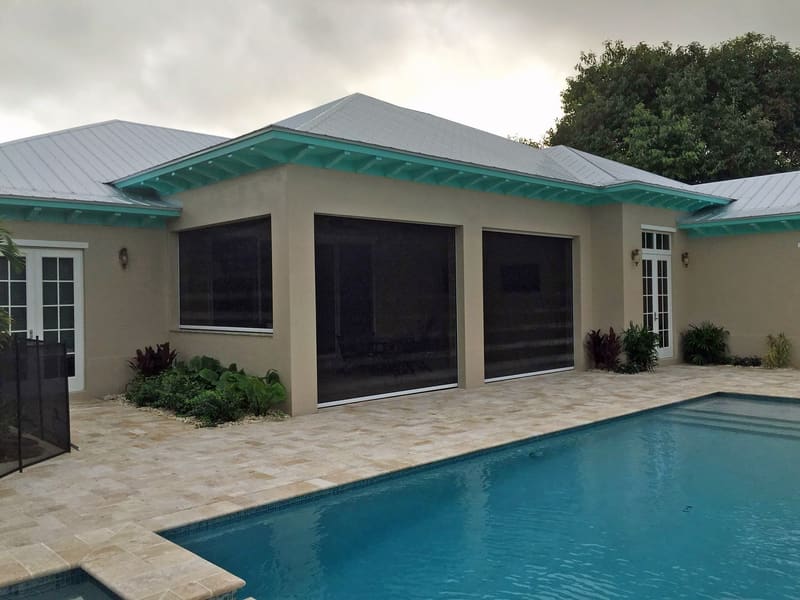
Hurricane screens vs shutters is really a question about how you want storm season to feel. Shutters, whether panels, accordions or roll-downs, protect individual windows and doors. A motorized hurricane screen protects an entire opening, such as a lanai bay, at the press of a button, and is something you can use every day. Here is how they compare on the things that matter.
The short answer
| Motorized hurricane screens | Hurricane shutters | |
|---|---|---|
| Storm prep | Press a button | Hang or close each one by hand |
| What it covers | A whole opening: a lanai bay or patio span up to 25 ft | One window or door |
| Light and view during a storm | Some light and view through the weave | Dark behind solid panels |
| Use between storms | Shade, rain, bug and debris protection | None, or stored away |
| Look when open | Hidden in a slim hood | Tracks, headers or stored panels |
| Price per opening | From $3,020, motor included | Varies by type |
Storm prep: minutes vs. hours
Hanging storm panels is a two-person job with a ladder and a stack of heavy, sharp-edged metal, and it tends to happen in the hottest, most stressful day before landfall. Accordion and roll-down shutters are quicker, but each window is still its own job. A motorized hurricane screen comes down in seconds per opening, and a single remote can run many screens. Lower them as soon as a storm is forecast, while the power is still on.
Strength and ratings
Shutters and hurricane screens sold in Florida are tested to the same kinds of standards: large-missile impact, static wind pressure and cyclic pressure. Fenetex MaxForce screens are tested under the Florida and Miami-Dade protocols and the matching ASTM standards, and are approved for the 185 mph wind zone, including the High-Velocity Hurricane Zone. For either product, the rating only holds if the product is approved for that opening and installed exactly as the approval drawings say; see how hurricane screens are installed.
Light, view and living through it
Solid shutters make a house dark for days. A hurricane screen’s OmegaTex fabric is woven from aramid fibers rather than formed from solid metal, so some daylight and a view come through even when it is down.
Fabric hurricane shutters vs. motorized screens
Fabric storm panels and hurricane screens use similar high-strength fabrics. The difference is that a fabric panel is still something you store, carry and attach before every storm, while a motorized screen lives in its hood and deploys itself.
The everyday difference
This is where hurricane screens pull ahead. Between storms, the same screen blocks up to 91% of UV, cuts glare and heat on a lanai, and keeps out rain, insects, dust and debris. Shutters do nothing for you on a sunny Tuesday in April.
When shutters still make sense
- Individual windows on a second story with no outdoor room to enclose.
- Tight budgets where only the openings code requires are being protected.
- Openings too small or awkward for a screen’s hood and tracks.
Many Florida homes use both: shutters or impact glass on the house windows, and hurricane screens across the lanai.
Roll down hurricane shutters vs. roll down hurricane screens
Roll-down shutters are the closest cousin: motorized, stored in a box above the opening. They are solid slats, so they block light completely. Hurricane screens are fabric, lighter, and usable as everyday shade.
Price it out
Enter your opening in the calculator to see the exact price of a hurricane screen for it. A 12 x 10 ft lanai bay is $4,300; a 16 x 12 ft bay is $6,190. See all hurricane screen details.