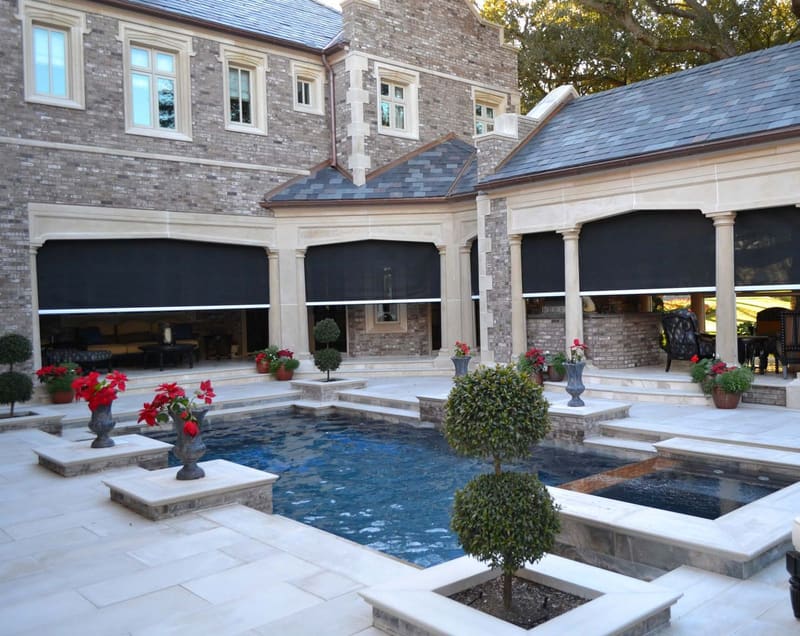
There are four types of motorized screens we sell, and each solves a different problem. The fastest way to choose is to name what bothers you most about the space: bugs, sun, weather or storms. This guide compares insect, shade, clear vinyl and hurricane screens side by side, with live prices.
The comparison
| Insect | Shade | Clear vinyl | Hurricane | |
|---|---|---|---|---|
| Main job | Keep bugs out | Cut sun, glare, heat | Block wind, rain, cold | Storm protection |
| See out | Easily | Yes, by day | Clearly | Yes, through the weave |
| Breeze | Most comes through | Reduced | Blocked | Reduced |
| Privacy | Low | Daytime (Dim Out: high) | None | Moderate |
| Fabric warranty (UV) | 5 years | 5 years | 3 years | 10 years |
| Max size, one screen | 25 ft × 17.25 ft | 25 ft × 17.25 ft | 25 ft × 16 ft | 25 ft × 20 ft |
| 8 x 8 ft price | $2,280 | $2,440 | $3,400 | $3,020 |
| 12 x 10 ft price | $3,180 | $3,460 | $5,070 | $4,300 |
All prices include the Fenetex Smart Motor and the hood; one remote comes with every order.
Insect vs. shade screens
Insect screens are what most people picture: a fine mesh that keeps mosquitoes and flies off the lanai while the breeze comes through. Choose standard, mosquito or no-see-um mesh; the tighter the weave, the smaller the bug it stops.
Shade screens use a tighter solar fabric. They take the edge off low afternoon sun, cut glare on screens and books, and give daytime privacy from the street. Textilene 95, for example, is rated to block up to 95% of the sun’s rays. You give up some breeze in exchange.
Pick insect if the space is shaded and the problem is bugs. Pick shade if the space faces west or south and the problem is heat.
Clear vinyl vs. shade
Clear vinyl screens are the weather wall: a clear panel with a solid border that closes out wind, rain and cold while you keep the view. They are the reason a porch or restaurant patio stays usable in winter. They do not cut sun or glare, and they need a polish twice a year to stay clear.
Pick clear vinyl if you want to use the space in bad weather. Pick shade if you want it cooler on sunny days.
Where hurricane screens fit
Hurricane screens are Fenetex MaxForce screens in OmegaTex fabric, rated for Florida’s High-Velocity Hurricane Zone. They exist for storms, but between storms they work like a sturdy shade screen, blocking up to 91% of UV and keeping out rain, insects and debris. They cost the most of the open-weave types, and they need careful, approval-compliant installation.
Mixing types
Each opening gets its own screen, so mixing is normal: hurricane screens on the storm side of a lanai, insect screens where you sit at dusk, clear vinyl on the windward side of a porch. One remote can run them all, and each screen goes up and down on its own.
Next steps
See real prices by size, measure your openings, then build and price your screens.